
Heresies IX: On Biobabble
How modern psychiatry rendered human experience into chemistry - and why it still holds sway

“If the brain were so simple we could understand it, we would be so simple we couldn’t.” - Lyall Watson
At some point, the language of psychiatry became strangely confident.
Depression was said to be a “chemical imbalance.” Anxiety a dysfunction of neurotransmitters. Trauma a dysregulated nervous system. These explanations carried the authority of science, offering clarity, legitimacy, and the promise of treatment.
But there is a problem.
Much of this language, while biologically framed, rests on remarkably thin empirical foundations. The explanations are often simplified, provisional, or speculative, yet they are presented as established fact.
David Healy has a name for this style of explanation: “biobabble.”
It is not biology, properly speaking. It is a way of talking about human experience in biological terms that creates the impression of scientific precision while obscuring uncertainty, complexity, and meaning.
The question is not simply whether these explanations are true or false.
It is what happens when we begin to understand ourselves through them.
Biobabble
Healy introduced the concept of biobabble in the late 1990s to describe claims such as the widely circulated idea that depression results from a “chemical imbalance,” particularly a deficiency of serotonin. While such claims gained enormous traction in both clinical and public domains, Healy argues that they bear little consistent relationship to measurable biological states. In this sense, biobabble refers not to biology itself, but to a form of biologically inflected language that functions rhetorically rather than scientifically. It simplifies, translates, and stabilizes complex human experiences into digestible, ostensibly medical explanations.
This critique is developed across several of his major works, including Let Them Eat Prozac, Mania: A Short History of Bipolar Disorder, and Pharmageddon. In these texts, Healy examines how psychiatric diagnoses and treatments have been shaped not only by scientific developments but also by pharmaceutical marketing, regulatory frameworks, and shifts in medical education. Within this ecosystem, biobabble operates as a kind of linguistic infrastructure: it enables clinicians, patients, and institutions to communicate efficiently, but at the cost of oversimplifying or misrepresenting the underlying phenomena.
The “chemical imbalance” theory serves as the clearest and most influential example. Initially presented as a causal hypothesis, it gradually became a heuristic and then a widely accepted explanatory narrative. Its success lies in its rhetorical power: it destigmatizes mental illness by framing it as biological, offers patients a clear and non-moralizing account of their suffering, and provides a straightforward rationale for pharmacological intervention. Yet, as Healy emphasizes, the empirical basis for this model remains weak. There is no consistent evidence that depression is caused by a simple neurotransmitter deficiency, nor that correcting such a deficiency directly resolves the condition.
Its persistence is not a failure of science, but a success of communication.
From Healy’s perspective, this illustrates how biobabble functions at an institutional level. It is not merely a matter of individual misunderstanding, but a product of systemic forces involving pharmaceutical companies, regulatory bodies such as the U.S. Food and Drug Administration, and the broader culture of evidence-based medicine. These forces collectively sustain a mode of discourse that translates uncertainty into apparent certainty and complexity into manageable, biologically framed explanations.
Importantly, Healy situates biobabble within a broader historical shift in psychiatric language. Where earlier generations relied on psychoanalytic explanations, or psychobabble, contemporary psychiatry increasingly turns to neurobiology. While this shift appears to mark scientific progress, it often reproduces the same structural features: authoritative language, simplified models, and a tendency to obscure rather than illuminate lived experience. In this respect, biobabble does not replace earlier forms of explanation so much as reconfigure them within a new scientific idiom.
The implications extend beyond theory into clinical practice and self-understanding. When individuals are told that their distress is the result of a chemical imbalance, their experience is reframed as internal, biological, and often chronic. This can reduce stigma, but it may also limit the space for interpreting suffering in psychological, social, or existential terms. Biobabble does not merely describe experience, it reshapes it.
Getting On My Last (Vagus) Nerve
This tendency to translate human experience into biological language does not end with neurotransmitters. It extends into broader models of the nervous system as well.
Polyvagal Theory, introduced by Stephen Porges, offers a biologically grounded model of emotional regulation centered on the autonomic nervous system, describing states such as “ventral vagal safety,” “sympathetic activation,” and “dorsal vagal shutdown.” In practice, these concepts are widely used to explain trauma responses and relational dynamics.
Problems arise, however, when such terms are treated as direct, measurable biological states rather than as interpretive constructs. Like the “chemical imbalance” theory, these explanations can give the impression of scientific precision while relying largely on inference from subjective experience rather than independently verifiable physiological markers.
From the perspective of biobabble, polyvagal language can function rhetorically by simplifying complex interpersonal phenomena into neurobiological categories, thereby creating a sense of explanatory clarity. This simplification may be clinically useful, but it can also obscure meaning, context, and the phenomenological richness of experience. As these concepts spread into therapy culture and popular discourse, they are often used in increasingly generalized ways, sometimes detached from their original scientific context, further reinforcing their rhetorical authority.
At the same time, important differences distinguish Polyvagal Theory from canonical examples of biobabble. It is not as closely tied to pharmaceutical marketing or regulatory systems, and it often retains a stronger emphasis on embodied and relational experience. The problem, therefore, is not the theory itself, but how it is used, particularly when biological language is taken to provide a definitive explanation where it may only offer metaphor or heuristic.
Recently Porges has been criticized for bad science and misrepresenting the function of the nervous system to support his theories. Scientific arguments against Polyvagal Theory and the chemical imbalance theory of mental illness can miss the point. They serve not as scientific fact but as powerful rhetorical frameworks for reshaping human experience.
Neo-Humoralism and Dehumanization
This impulse to explain human experience through biological balance is not new.
In antiquity, the physician Galen understood the body as governed by the interplay of four humors: blood, phlegm, yellow bile, and black bile. Health was a condition of equilibrium; illness, a disruption of balance. These humors were not merely biological substances but part of a broader cosmological framework linking body, mind, and world.
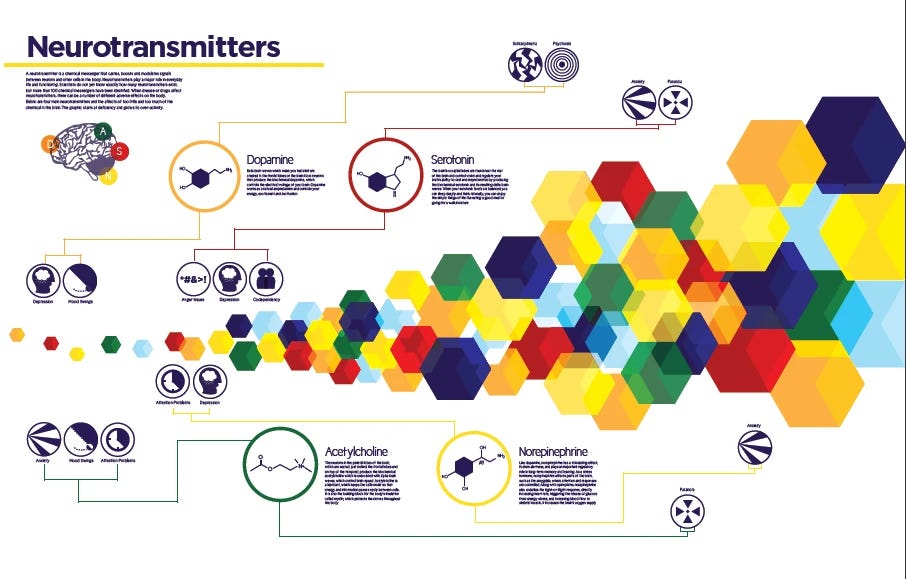
Modern psychiatry, in its popularized form, appears to have revived this structure in a reduced form. Neurotransmitters replace humors; imbalance replaces dyscrasia. Serotonin, dopamine, norepinephrine, and GABA take the place of blood, phlegm and bile.
But the resemblance is superficial. Where Galen’s model was expansive and interpretive, the chemical imbalance theory is reductive. It compresses complex human experience into a simplified biological schema, often detached from the broader context of a person’s life.
For decades, the public has been encouraged to understand suffering in these terms. In more recent years, some within psychiatry have distanced themselves from the chemical imbalance model, describing it as a heuristic rather than a literal claim. Yet its effects remain. It provided psychiatry with a language of medical legitimacy and offered pharmaceutical interventions a clear rationale.
Psychotherapists, too, have often adopted biologically inflected language, often uncritically. In doing so, they may rely on scientific-sounding frameworks to lend authority to practices that remain fundamentally interpretive. This substitution of technical vocabulary for genuine understanding can obscure rather than clarify the nature of human distress.
More significant than any individual misuse is the broader cultural transformation. As W. H. Auden once wrote of Freud, a theory can become “a whole climate of opinion.” Biobabble has achieved something similar. It has reshaped how people speak about themselves, encouraging a view of the self as a system of chemical processes to be monitored and optimized.
Enframing the Human
At its deepest level, this transformation is not merely scientific or clinical, but philosophical.
Martin Heidegger described modern technological thinking as a mode of revealing he called enframing (Gestell), in which the world appears as a set of resources to be measured, controlled, and optimized. Within this framework, human beings themselves come to be understood in similar terms.
Biobabble can be understood as the linguistic expression of this shift. Mood is no longer encountered as a way in which the world is disclosed, what Heidegger calls Stimmung, but is redescribed as an internal neurochemical state, a problem of dysregulation to be corrected. Terms like “serotonin imbalance” do not only simplify; they translate lived experience into technical variables.
In doing so, they render the person as a kind of standing-reserve (Bestand), a system available for monitoring, adjustment, and optimization. Questions of meaning are displaced by questions of control. The individual becomes something to be managed rather than understood.
This is the deeper danger. Not that biological explanations are false, but that they become totalizing, crowding out alternative ways of understanding human experience and reshaping how individuals relate to themselves at the most fundamental level.
What is Lost
Sadness becomes low serotonin. Anxiety a deficiency of GABA. Love a surge of dopamine and oxytocin. Trauma a nervous system response.
What is lost is not only accuracy, but meaning.
Biobabble encourages us to encounter ourselves not as persons, but as systems to be regulated. Life is no longer something to be lived, but something to be managed.
To adapt Hemingway: it was a brilliant theory, but we lost the human.
I love this perspective, and I think it's brilliant looking at all of these models as different frameworks rather than absolute truths, and using all of these lenses as different ways to help people understand themselves.